LearnMap2026
Project Summary
LearnMap is a modern reimplementation of the KitBuild Concept Map platform, originally developed by the Learning Engineering Laboratory at Hiroshima University. Built as part of my bachelor thesis, it recreates the proven KitBuild pedagogy — concept map reconstruction for formative assessment — on a modern web stack, and extends it with the segmentation experiment that my research focuses on.
Yes, this is a thesis project. That sentence alone explains the git history at 3 AM. But unlike most thesis projects, this one didn't get abandoned two weeks after the defense — it's deployed, it runs, and it diagnoses student misconceptions better than my sleep schedule ever diagnosed itself.
The Problem
The original KitBuild system has been operational since 2009 and is used across 1700+ institutions, but its stack shows its age. Researchers who want to run concept-map experiments need external tools for questionnaires, manual kit preparation, and offline score analysis. My thesis also needed a platform that could compare two segmentation models (Paragraph vs Depth-Topic) for distributing kit segments to students — something the original system does not support.
The Solution
LearnMap reimplements the full KitBuild workflow: instructors draw a goal map in a visual concept-map editor, the system disassembles it into student-ready kits, students reconstruct the map, and the engine automatically diagnoses the result against the goal map to surface misconceptions. The thesis experiment is built in as a first-class feature: a goal map can be segmented into ordered kit segments using either the Paragraph or the Depth-Topic model, so both conditions can run on the same platform and the same data model. Everything — pre-test, post-test, delayed test, questionnaires, analytics, CSV export — lives in one place, deployed on Cloudflare Workers with LibSQL/Turso, so no VPS is required.
Key Features
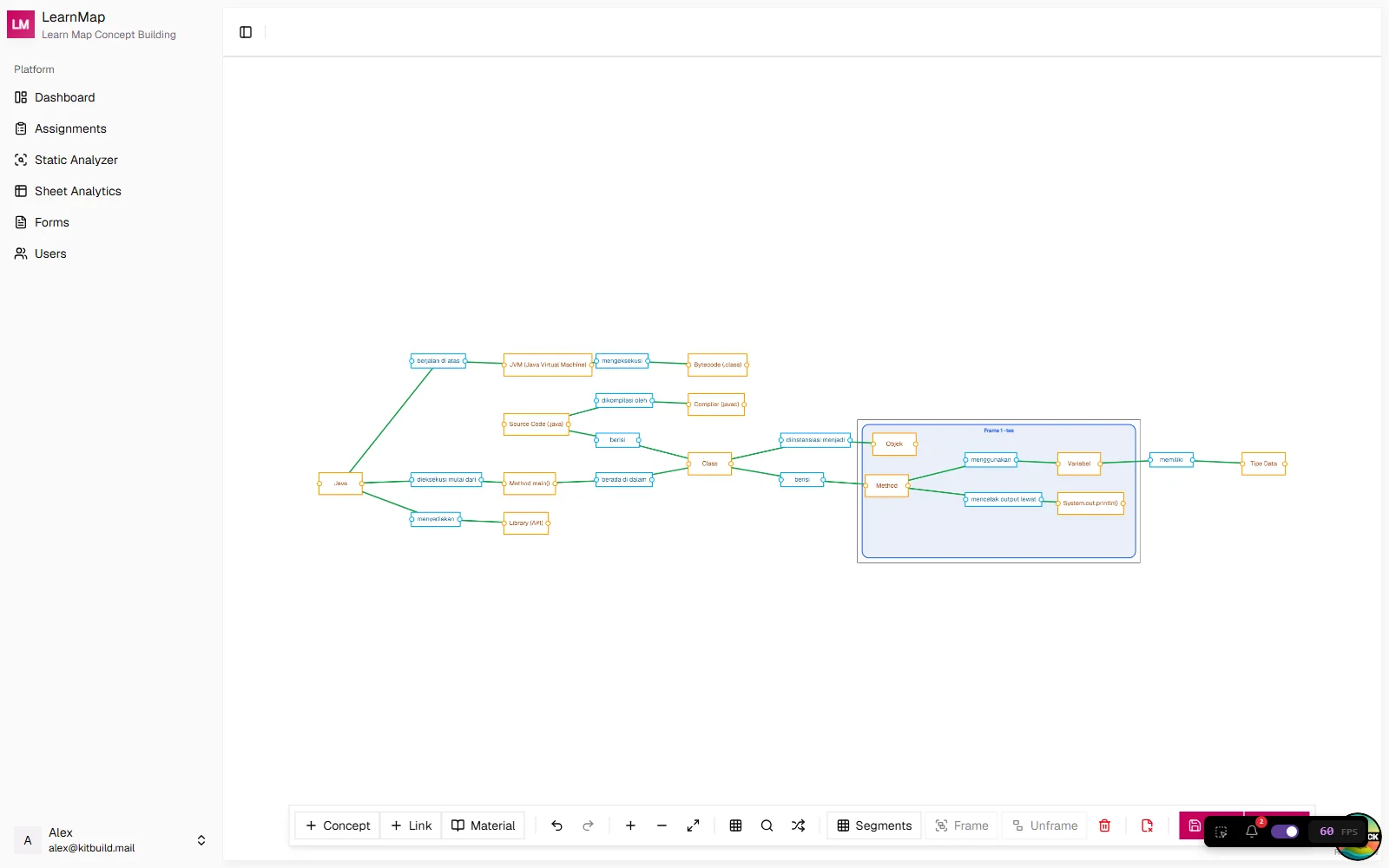
- Concept Map Editor — visual editor for goal maps with bi-directional and multi-link support, named/colored visual frames, and drag-and-drop canvas built on XYFlow.
- Automatic Kit Generation & Diagnosis — goal maps are disassembled into kits; learner maps are automatically compared against the goal map with targeted feedback.
- Segmentation Models — Paragraph and Depth-Topic segmentation split a goal map into the kit segments students work through, in order — the core of the thesis experiment.
- Extended Assessments — quiz builder for MCQ, short answer, and Likert-scale questions with Aiken format import/export and "Show Answer" review control.
- Assignment Management — deadlines, time limits, access control, and per-assignment forms (pretest/posttest/questionnaire).
- Research Dashboard — analytics sheets, per-student results, and exportable CSV for research analysis.
Technologies Used
- TanStack Start — full-stack React framework with SSR and type-safe routing.
- Effect — typed functional core for services and error handling.
- Drizzle ORM + LibSQL/Turso — schema-safe data layer.
- Cloudflare Workers — edge deployment with R2 for material images.
- Tailwind CSS v4 + shadcn/ui for the interface.
Attribution
All core assessment methods come directly from the original KitBuild research (Hirashima et al.). LearnMap introduces no new pedagogy — it reimplements proven methods in a maintainable form. The procrastination, however, is entirely original work.